
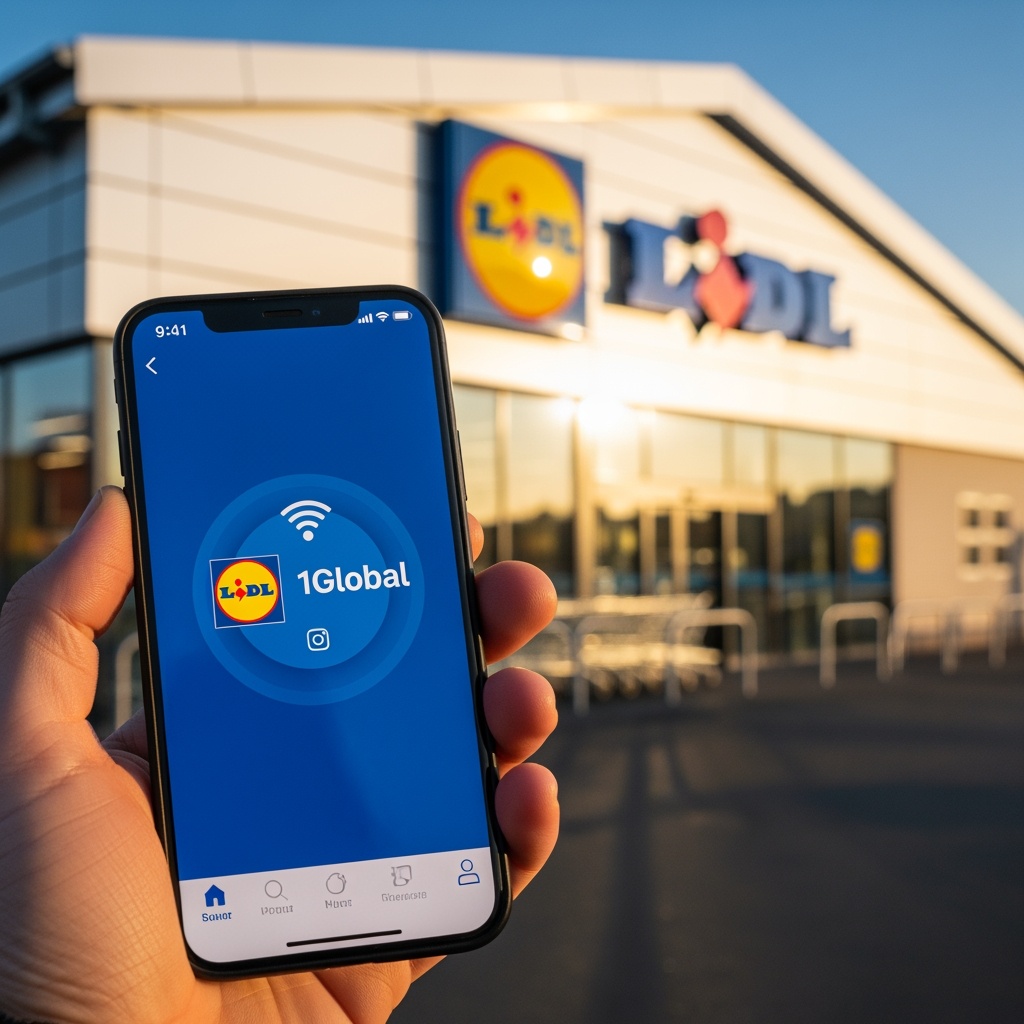
Could the Lidl 1GLOBAL MVNO announcement signal a new wave of retail MVNO growth in Europe?
This week’s announcement about Lidl’s plans to launch an MVNO in up to 30 markets is substantial news for the industry. Made even more so by the fact that Lidl has taken a stake in 1GLOBAL to make it happen.
Launching a retail MVNO is, of course, not a new idea. We’ve seen this happen all over the world. But I think it’s the scale that is breathtaking. It’s a huge statement of strategic intent from both sides, and a reminder that retail MVNOs remain one of the most powerful, and, in my opinion, underutilised, growth levers.
Lidl’s ambition to leverage its retail footprint in multiple countries, combines ingredients successful retail MVNOs boast, including the option to distribute at scale and capitalise on high levels of consumer trust.
Coupled with access to 1Global’s digital expertise, Lidl is on the road to creating a compelling mobile proposition that can be set directly into the retail experience.
The case for retail MVNOs
Looking back over the last five years, MVNO performance has rocketed and, in some countries, MVNOs post better growth than their operator hosts.
Close to home, retail MVNOs account for over 40% of all MVNO subscribers in the UK. Tesco Mobile alone has over 5 million subscribers and has successfully expanded into Ireland, the Czech Republic, and Slovakia.
Alongside it, brands like Asda Mobile, iD Mobile (from Currys), Coop Mobile, and Superdrug Mobile are showing that a close bond between the mobile and retail experience pays off.
You don’t even have to be trading with shops either, as proved by AO’s announcement last June, that it too will launch an MVNO very soon.
Internationally, the success stories are just as compelling. The standout example is the market disruptor Bait, Walmart’s MVNO in Mexico. It’s seen extraordinary growth and now holds the number two spot in market share, outperforming two established network operators.
On the other side of the world, Aeon in Japan, and Woolworths in Australia, are great examples of retail MVNOs that work because they already had so many of the ingredients critical for a successful retail MVNO.
So why do retail MVNOs work?
Having worked across multiple retail MVNOs, including iD in Ireland, Coop Mobile in the UK and Channel Islands, Asda Mobile, Superdrug Mobile, and even the now-retired Mobile by Sainsbury’s, I’ve seen firsthand what separates the successes from the also-rans.
It comes down to a few critical factors.
1. Unmatched customer access
The first, and arguably most important advantage is customer access.
Retailers like Asda and Tesco have tens of millions of customers passing through their stores every week. That level of engagement dwarfs what traditional mobile operators can achieve. Mobile is a low-frequency interaction; grocery retail is often weekly, if not more.
Retailers also typically enjoy significantly higher Net Promoter Scores (NPS) than telecom operators. In simple terms, customers like supermarkets more and are willing to switch to them for their mobile.
2. Low customer acquisition costs and high lifetime value
Retailers with stores are perfectly placed to convert footfall into SIM sales at a fraction of the cost incurred by traditional operators. They have the space in store to allocate to sales either as concessions, or SIM displays at checkouts, and the staffing is taken care of. Plus, with a steady stream of customers through the door, there’s no need for expensive above the line marketing campaigns to drive awareness and footfall.
This dramatically lowers customer acquisition cost (CAC) and gives retailers the flexibility to invest more in customer offers such as bigger data bundles, better loyalty rewards, and / or compete aggressively on price.
Retail MVNOs perform exceptionally well on key metrics like margin per square foot. I’ve seen how a small footprint in-store can generate disproportionately high lifetime value (CLV), especially when compared to the relatively thin margins on everyday grocery items.
3. Integration with loyalty
The real magic, however, lies in integration. The most successful retail MVNOs don’t treat mobile as a standalone product. They embed it into the broader shopping experience. This is where many weaker propositions fall.
When mobile is linked to loyalty schemes, member pricing, or exclusive discounts, it becomes far more compelling. Customers aren’t just buying a SIM, they’re unlocking additional value with a retailer they already engage with and trust.
And the benefits are felt both ways. Mobile drives retail, and retail drives mobile. As not only does the MVNO generate incremental, recurring monthly revenue, but it also drives the core retail business.
Some of the best retail MVNOs I’ve seen, incentivise customers to increase their visits to store, and how much they spend using loyalty point accelerators, discounts, and vouchers. This results in significantly higher retail basket spend and improved customer loyalty.
4. Customer perception is king
Trail blazers like Tesco and Aldi Talk legitimised retail MVNOs 20+ years ago and won over generations of consumers who only grew up with the option of a big operator. The latest generation of mobile users have never known a market without MVNOs. The net result is that brand loyalty to MNOs has waned, and there’s a readiness to switch to brands that are not traditionally associated with telecoms.
Lidl and 1GLOBAL make for a winning combination
Lidl knows it can achieve the same results. It brings enormous scale, a strong value-led brand, and a growing digital and loyalty capability, and when blended with 1GLOBAL’s technical infrastructure and international reach, they’ll be able to execute across multiple markets.
And, dare I say, with brands like Revolut in the 1GLOBAL stable who knows where Lidl could branch out to. Banking and financial services is also a fast growth MVNO segment. I wouldn’t be surprised if there’s a longer-term strategy there.
Whatever the future holds, for now they have the ingredients for a highly competitive retail MVNO proposition, and it should prompt other retailers, especially in the UK, to stop and think.
There are plenty of brands with the scale, loyal customer base and infrastructure to make a retail MVNO work. Morrisons More, Boots and its Advantage card, and the various Co-operative groups, spring to mind as contenders. Even Sainsbury’s, despite the previous exit of Mobile by Sainsbury’s, could revisit the opportunity, particularly given the strength of the Nectar scheme today.
Given the grocery market is so competitive and the challenger brands are not only taking share and winning the price wars but now sharpening their focus on growth through MVNOs, it would seem fool hardy for other retailers to be complacent.
In my view, this will spark the next wave of retail MVNOs. Because when one retailer moves, others follow.
20 years ago, retail MVNOs felt like a risk. Why would a brand take money from the business to invest in an unproven model, when you could build another store, refurbish one to add new product line or even buy a competitor?
But now the numbers stack up. The model is proven, with global success stories and strong underlying economics. We talk about their merit every year at MVNOs World because they work. Not only that, MVNOs work hard for their parent brands.
For retailers sitting on the sidelines, the question isn’t whether this model works. It’s whether they can afford not to be part of the next generation of retail MVNOs. Those that dally, genuinely risk losing out to competitors on both customer numbers and incremental revenue.
So, if you want to be part of the new era but need help with the proposition, the business case, technology choices, or wholesale contract, then Graystone Strategy can help. Our team have negotiated and launched many successful retail MVNO and are perfectly placed to get your strategy off the ground. To get in touch click here.
You can also book a face-to-face meeting with us at MVNOs World, June 1-3rd in Amsterdam here.
