
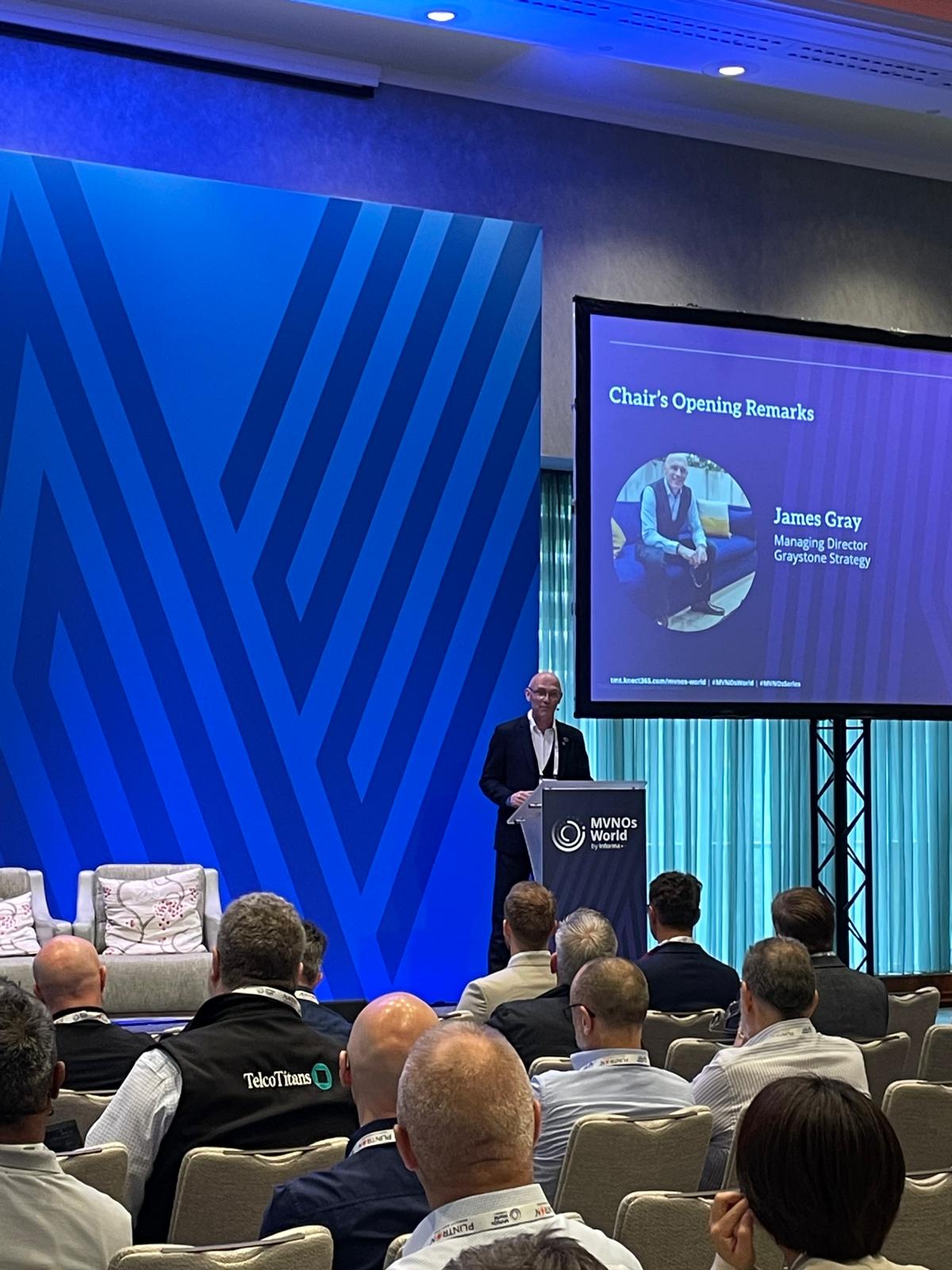
Satellite, consolidation and ARPU – the hot topics at this year’s MVNOs World
THE STATE OF THE MVNO MARKET
The global MVNO market is currently worth around $95 billion and by 2035 it’s expected to grow to well over $190 billion. Staggering as these numbers are, I don’t believe they are hype.
Growth is coming from across the world in both emerging and mature markets.
In Latin America, Africa, Southeast Asia digital-first propositions enabled by ‘MVNO-in-a-box’ and SaaS solutions are creating opportunities for new entrants in emerging markets.
Growth in the mature markets of Europe and North America is coming from enterprise IoT, targeted consumer propositions, and the fascinating trend of using mobile not just as a revenue stream, but as a critical part of the strategy to deepen loyalty with existing customers.
Just last month, Lidl and 1GLOBAL announced a partnership that will see the supermarket chain become an MVNO in up to 30 markets, embedding eSIM plans directly into its Lidl Plus loyalty app, which already has over 100 million users.
Then there’s Bait, Walmart’s MVNO in Mexico, proving the power of a focused strategy. It ended 2025 with 26.4 million active users, up 44% in a single year, adding 8.1 million subscribers, net.
Bait has achieved this incredible growth by deeply integrating mobile into the Walmart retail experience. It’s a simple and effective proposition giving people free data with in-store purchases, supported by activation across 3,000 outlets.
The results speak for themselves. Bait customers spend two and a half times more in Walmex stores than a non-customer. That statistic alone tells you everything about why retail and mobile are such powerful allies and how mobile has become a critical element to numerous brands’ growth strategies.
Neo-bank MVNOs are also gaining serious momentum. Revolut, Lendable, N26, Monzo, to name a few, are weaving mobile into their financial services ecosystems.
And in the community space we have seen everyone from influencers to US presidents, sports clubs to religious groups embrace the MVNO model.
But the conference is not just a celebration of growth. It is a place where we interrogate the hard questions too, and this year there will be three critical themes.
THEME ONE: THE SATELLITE QUESTION – OPPORTUNITY, RISK, OR INDUSTRY EARTHQUAKE?
Let me start with the one I think carries the biggest long-term strategic implications: Satellite.
In March, at Mobile World Congress in Barcelona, SpaceX took to the stage to unveil Starlink Mobile, its direct-to-device service. This followed T-Mobile’s launch of T-Satellite, in partnership with SpaceX, in 20025 with plans for next generation ‘V2 satellites’, targeting 5G-class speeds from orbit, in 2027.
Amazon is also getting in on the action with Amazon Leo, a low-Earth orbit broadband constellation targeting over 3,200 satellites. It’s currently working on partnerships to monetise this new asset. I don’t think Amazon will dabble in this market. It will dive in hard with every intention of disrupting the market by building a global network, just as they’ve done in retail, cloud computing, entertainment and logistics.
So, at conference we’ll ask at what point does satellite connectivity starts to replace the mobile infrastructure of today.
We have already seen WIFI take share of customers use in the home. Will we see satellite connectivity also taking traffic away from traditional networks, and if so, will they do it in partnership with operators or in competition with them?
This won’t happen today but it’s a question we need to be ready to answer. Experts agree that physics and economics make satellite a complementary technology to terrestrial networks at present, but V2 satellites promise one hundred times more data density than V1 and that is a whole new ball game.
If satellite becomes an alternative provider, then the asset that operators have spent decades and tens of billions building and that MVNOs rely on could become redundant, or at least less crucial in some areas.
This brings risk and opportunity. On the risk side, Starlink’s current T-Mobile partnership explicitly excludes MVNO access, and we may well see this approach adopted more broadly.
If satellite capabilities are locked within operator brands, then MVNOs could find themselves excluded from a major new technology wave, exactly the scenario we at Graystone Strategy advise clients to contract against.
Parity of access clauses in your wholesale agreement are not a nice-to-have; in a world of rapidly evolving technologies, they are protection against a very real threat.
On the opportunity side, this trend has the potential to significantly re-write how consumers access mobile telecoms. We could even see a world where every telecoms brand is an MVNO accessing connectivity from national radio network and satellite combined.
That type of shift needs innovative thinkers that can rip up the rule book and start again. That type of thinking is present at MVNOs World. As a community we are world champions at challenging the status quo and doing things differently.
THEME TWO: CONSOLIDATION – THE DOUBLE-EDGED SWORD
Europe’s mobile network operators have been pushing hard for permission to consolidate. They are being successful and generally, that’s bad for MVNOs as fewer operators means fewer potential wholesale partners. And less competition in wholesale almost always means higher prices and less favourable terms.
But – and this is the critical counter-narrative – consolidation historically comes with regulatory remedies which are an important catalyst for MVNO growth. We have seen a range of remedy models deployed in the UK, Ireland, Austria and even the Channel Islands, all seeking to drive consumer competition through MVNOs.
We’ve also seen a more radical solution deployed in Mexico. The Red Compartida (Altan Redes) was effectively born from the need to inject wholesale competition into a market dominated by Telcel. Today, 83 MVNOs use that network, and it’s worth noting Bait built its entire 26-million subscriber empire on it.
We’ll discuss in detail how MVNOs can manage these changing dynamics and refine strategy to ensure opportunity is maximised and the risks are minimised.
THEME THREE: CHANGING CONSUMER HABITS – THE MARGIN SQUEEZE AND THE PROPOSITION OPPORTUNITY
The third theme is about how consumers are using their phones, from the changing use cases, technologies and attitudes to mobile, to the economics of mobile data.
Let me start with the economics. Data usage is going up. In 2025, 93% of operators globally saw growth in data usage per subscription.
But here is the problem, ARPU is not keeping pace. Across all markets, we are seeing a growing gap between the cost of serving that data and the revenue earned from doing so.
The result is a margin squeeze that is hitting MVNOs particularly hard, because MVNOs have the added layer of a wholesale cost they cannot fully control.
There are broadly two responses to the margin squeeze. The first is using tech to reduce operational costs. AI has a huge role to play here supporting a less costs more margin approach.
The second, and in my view the more interesting, is the race to build propositions that escape the commodity trap entirely and grow value.
Which brings me to the second dimension of changing consumer habits, the social and cultural shift that is creating entirely new proposition opportunities for this industry.
Across the world, parents, governments and regulators are waking up to the impact of uncontrolled social media access by children. Australia has legislated a ban on social media for under-16s, and many more countries are putting this issue under the microscope.
This is not just a policy trend. It is a consumer behaviour shift. More parents are actively looking for technology solutions that keep their children connected AND protected.
They want their kids to have a phone, but not a portal to unregulated content. They want to give independence while maintaining visibility, and they are willing to pay a premium for that reassurance.
Spacetalk, an Australian MVNO and technology company, has created a proposition purpose-built for families offering child tracking, check ins and full parental content controls.
This allows kids freedom, but within parental guardrails, making parenting in this digital age just a little less stressful. Spacetalk is pursuing white label deals on its technology, already securing one with Vodafone Australia. For pioneering MVNOs, there’s a huge opportunity to seize on this openness to partnership. Done well it has the potential to overcome the ARPU squeeze.
The trick MVNOs need to take from this is not to compete on price for the same generic data plan but identify a segment with a specific pain point and build a proposition so differentiated that price becomes secondary to value.
It’s also a reminder that cost cutting isn’t always the way to go and building customer relationships is.
So, there you have it three themes for congress, and as we’ll no doubt discuss, endless possibilities for success.
If you would like to discuss how you adapt your MVNO’s strategy to address one or more of these themes then drop us a line, we’re happy to meet for a coffee during the conference, or a video call afterwards.
